
You’re sipping lukewarm coffee at your kitchen table. Half your countertop is ripped out. There’s painter’s tape on the light switches. The guy you hired, a “friend of a friend”, was supposed to show up two days ago. Your texts? Still unread. And now your neighbor’s asking if your remodel’s abandoned.
You laugh it off, but deep down, the stress is real.
That’s what it feels like when you pick the wrong general contractor in Long Beach. And it happens more than anyone likes to admit, especially in a city where old wiring, strict permit zones, and surprise foundation issues are just part of the game.
Long Beach homes aren’t cookie-cutter. They’re layered, historic, sometimes finicky. They need someone who’s done more than glance at a blueprint. They need someone who’s walked the blocks, knows the city inspectors by name, and understands how to build without drama.
That’s where this guide comes in. No fluff. No buzzwords. Just real talk about how to find a contractor who’ll treat your home like it’s their own, because that’s the only kind worth hiring.
You Don’t Need 10 Contractors. You Need One Who Gets Long Beach.
Ask around, and everyone’s got a contractor story.
The neighbor in Belmont Shore whose backyard project stalled for three months because their guy “didn’t realize” a retaining wall permit was required. The couple in Los Altos who thought they scored a deal—until the city red-tagged their ADU mid-build. Or the family near Bixby Knolls who had to gut and redo their kitchen twice because the electrical work failed inspection… both times.
These aren’t just unlucky stories. They’re what happens when someone hires a contractor who doesn’t understand Long Beach from the inside out.
See, every neighborhood here is its own little ecosystem.
- Bluff Heights has historic overlays that limit what you can touch—and how.
- The Peninsula has strict coastal development restrictions.
- Cal Heights hides decades-old framing quirks behind pretty plaster.
A general contractor in Long Beach doesn’t just need a license. They need fluency in our city’s codes, workflows, and character.
At Recast Industries, we’ve worked jobs where the plans had to be redrawn after permits were pulled. We’ve helped clients who inherited half-finished remodels from contractors who ghosted. We’ve walked into homes where the tile looked great—until you stepped on it and felt the void underneath.
That’s why you don’t need a flashy ad or a hundred bids.
You need one contractor who gets your vision, gets your zip code, and gets it done right.
12 Questions to Ask Before You Even Think About Signing Anything
Before you sign anything, pause, pour yourself a coffee, walk through your home, and look at that kitchen you want to gut or that old garage you’re turning into a sleek ADU. Then ask yourself: Who’s going to get this right without wrecking your sanity or your savings?
These 12 questions are more than due diligence, they’re your emotional insurance policy. They’ll protect your peace, your project, and your budget. Let’s dive in.
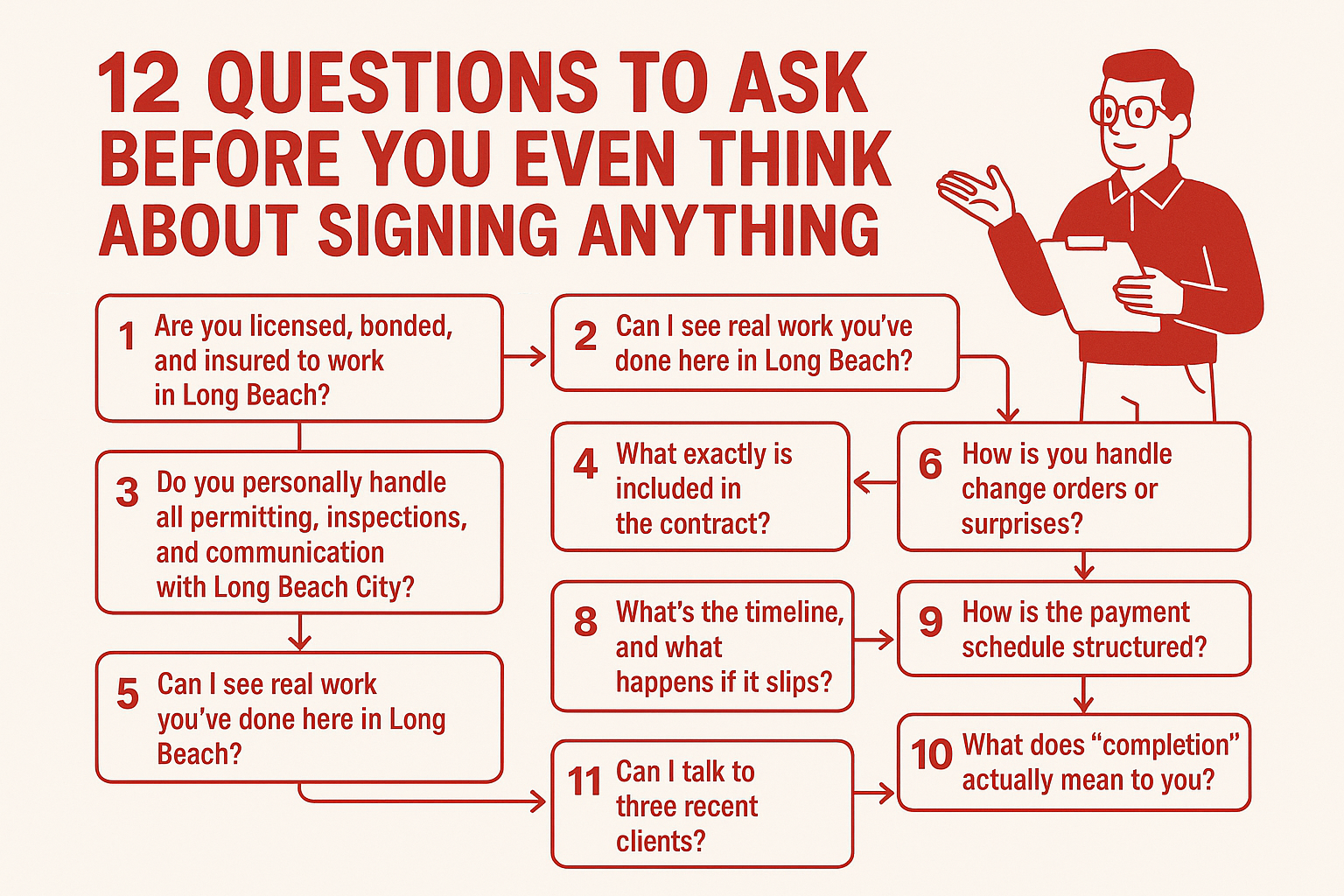
1. Are you licensed, bonded, and insured to work in Long Beach?
This isn’t a formality. You’re trusting someone with your home, your most personal investment. Make sure they can prove a valid California state contractor’s license, general liability and workers’ comp insurance, and a bond that covers potential damages.
Ask for documents, confirm the license online. If you hear, “We’re still updating it,” or “Don’t worry about that,” it’s a red flag.
2. Do you personally handle all permitting, inspections, and communication with Long Beach City?
You shouldn’t have to become a zoning expert to get your remodel approved. Ask who submits the plans, who deals with the city inspector, and whether they have experience with Long Beach’s quirks like historical preservation areas or coastal development rules.
A good contractor handles it all and explains it in a way you understand.
3. Can I see real work you’ve done here in Long Beach?
Stock images and slick Instagram feeds aren’t proof. Ask to visit finished projects in neighborhoods like Belmont Shore, Bluff Heights, or Bixby Knolls. A credible contractor should offer local references, let you drive by finished sites, and show a range of styles that match your own vision.
The goal? You want confidence they can adapt, not just replicate the same look everywhere.
4. Who will I communicate with day to day?
If you’re passed from a sales guy to a PM to an unknown site crew, things will fall through the cracks. Ask if you get a dedicated project manager, what the response time on questions is, and whether there’s a shared calendar or app to track progress.
Your project should never feel like a game of telephone.
5. What exactly is included in the contract?
A solid contract should be your safety net, not a trapdoor. Ask for clarity on labor, materials, and contingency allowances, appliance installation, finish carpentry, and cleanup, and language around scope changes and additional charges.
If it sounds vague, or if the contractor avoids specifics, don’t sign. It should read like a roadmap, not a riddle.
6. How do you handle change orders or surprises?
Things can go sideways—rot behind drywall, plumbing misroutes, city delays. Ask what the protocol is for unexpected costs, whether you’ll get notified in writing before changes are made, and how flexible the timeline is if surprises show up.
You’re not asking for perfection—just honesty, process, and control.
7. What’s the timeline, and what happens if it slips?
You deserve more than “eight to twelve weeks.” Ask if they can break it down by phase, what the milestone dates are, and how delays get communicated and handled.
They should tell you how long demo takes, when inspections happen, and what can cause holdups. Vague means dangerous.
8. How is the payment schedule structured?
You should never feel pressured to pay ahead of progress. Look for clear milestones tied to deliverables, final payment withheld until walkthrough and punch list is complete, and receipts and documentation for every payment.
If a contractor asks for 50 percent upfront, walk away.
9. Do you use a consistent crew, or subcontract everything out?
Subs aren’t bad, but poor vetting is. Ask who does the tile, the electrical, the painting, how long they’ve worked with them, and whether they’re licensed and insured too.
Familiar crews mean smoother builds and fewer surprises.
10. Can I talk to three recent clients?
You want to hear from homeowners like you. Ask what they loved, what went wrong and how it was handled, and whether they would work with the contractor again.
The answers matter more than the portfolio.
11. What does “completion” actually mean to you?
Some crews vanish once the last switch plate is on. Others stay for walkthroughs, punch list corrections, and deep cleaning and post-job documentation.
Clarify that you’ll be part of the sign-off. You should feel proud, not pressured, on handover day.
12. What happens if something goes wrong after the job is “done”?
Let’s say a cabinet door warps or a faucet leaks in three weeks. Ask if they offer a warranty and if it’s in writing, who to call if you spot an issue after move-in, and whether they’ll still take your call a month later.
Peace of mind shouldn’t end when the truck pulls away.
Long Beach homeowners, you’ve seen what happens when these questions don’t get asked. We’ve seen clients left mid-reno, fighting for refunds, or stuck patching up half-baked jobs. These 12 questions, they’re your shield. If your contractor can’t, or won’t, answer them clearly, keep looking.
Skip the Buzzwords, Here’s What a Great Contractor Actually Does
Let’s be honest. Anyone can slap “licensed,” “reliable,” or “full-service” on their website. Those words lose their meaning fast when your kitchen’s torn up, your timeline’s slipping, and you can’t get a straight answer from your contractor. In Long Beach, where ocean air rusts tools and homes carry decades of character, you need more than a slick sales pitch.
You need someone who actually shows up—for the job, for the unexpected, and for you.
They don’t just hear you—they get you
A real contractor doesn’t treat your project like another job number. They step into your world. They ask how you use the space now, how you want to feel in it after, what bugs you most, what lights you up. They pick up on your hesitations, your must-haves, your silent cues. It’s less about flashy mood boards and more about, “Would a pull-out pantry here make mornings easier for you?”
They speak in sketches, photos from past projects, local vendor samples you can touch—not abstract terms. You feel seen, not sold to.
They anticipate issues before they happen
Great contractors walk your home like detectives. In Long Beach, that means knowing how humidity creeps in, how older stucco can hide hairline cracks, how some neighborhoods need extra signoffs to pass city inspection. They’re not guessing—they’re preparing.
You might hear things like, “We’ll need to open this up to check if the framing’s still true,” or “Based on the lot line, I’d recommend talking to permitting early.” These aren’t red flags—they’re safety nets. Because a good contractor builds solutions before problems make it to your inbox.
They run the project like clockwork, not chaos
It’s not just about showing up. It’s about showing up ready. You’ll notice:
- Crews that show up on time, not on their own schedule
- Supplies that arrive before the job stalls
- Protective mats, sealed vents, and swept floors that show respect for your home
Everything moves with quiet confidence. When surprises hit—and they will—you’re not bracing for disaster. You’re getting a quick call with solutions, not excuses.
They sweat the stuff you never thought to ask
You’ll admire the way the pendant light hangs. They’ve already accounted for ceiling joists, wire routing, and the exact height so it doesn’t block your sightline.
Every joint lines up. Every drawer closes like butter. The paint edges are crisp. The grout is uniform. You don’t need a contractor who “meets expectations.” You need someone who makes you notice the craftsmanship when you’re brushing your teeth a year later.
They follow up—long after the last sweep
You know those contractors who vanish once the check clears? The ones you call and never hear back?
The best ones don’t ghost. They’ll swing by a month later to tighten that loose knob. They’ll remind you it’s time to seal the deck again next spring. They stay in your phone—not just for fixes, but because you trust them.
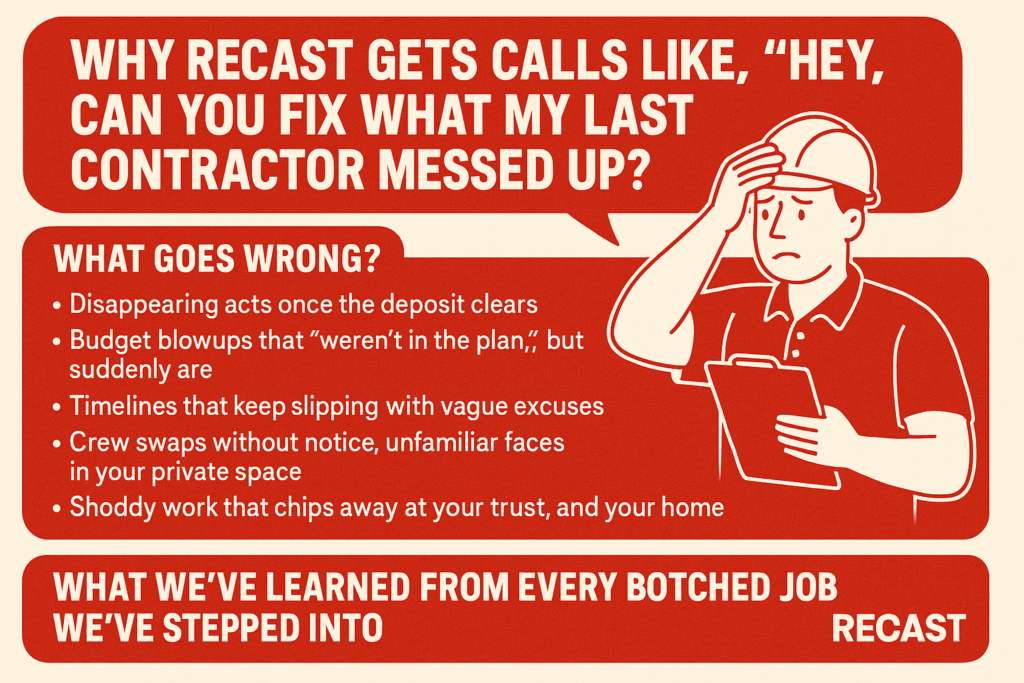
Why Recast Gets Calls Like, “Hey, Can You Fix What My Last Contractor Messed Up?”
Here’s a truth homeowners in Long Beach know all too well, some contractors leave behind more dust than progress. We’ve taken the reins on half-done kitchen remodels, sagging additions, and backyard builds that should’ve never passed inspection. Not because we’re looking to poach work, but because too many folks get burned before they find someone who actually listens, delivers, and gives a damn.
It usually starts with a nervous call. The voice on the other end sounds frustrated, sometimes even embarrassed. “We thought we did our homework,” they say. “They came recommended, but it was a nightmare.”
Here’s the thing, the problem isn’t you. It’s that too many contractors rely on charm up front, then vanish when things get complicated. They promise smooth timelines, perfect finishes, and on-budget miracles, but leave you ghosted when reality sets in. And suddenly, your family’s routine is shattered, your weekends are spent chasing updates, and your savings account starts shrinking fast.
What Goes Wrong?
Disappearing acts once the deposit clears
Budget blowups that “weren’t in the plan,” but suddenly are
Timelines that keep slipping with vague excuses
Crew swaps without notice, unfamiliar faces in your private space
Shoddy work that chips away at your trust, and your home
It’s not just the financial hit, it’s the emotional toll. You start second-guessing your choices. You feel trapped, angry, and overwhelmed. The project that was supposed to bring joy becomes a stress anchor that affects your sleep, your work, your family dynamics.
And here’s the kicker, you might even stop dreaming about your ideal home. That’s the real loss — when frustration replaces inspiration.
What We’ve Learned From Every Botched Job We’ve Stepped Into
Every fix-it call we get sharpens our radar. We’ve learned to spot the red flags others miss, like overly generic quotes, refusal to pull permits, or vague answers to direct questions. We ask the questions you didn’t know you needed to ask. We document every decision, every dollar, every timeline. Because rebuilding your space also means restoring your confidence.
You shouldn’t have to micromanage the process just to protect your home. You shouldn’t feel like you’re holding your breath every time a contractor sends a text. But after a bad experience, it’s hard not to.
That’s why so many homeowners in Bluff Heights, Belmont Shore, and across Long Beach come to us not just for the project, but for the peace of mind they thought was lost.
Let’s rebuild your space, and along with it, your faith in the process.
FAQs
What should I look for when hiring a general contractor in Long Beach?
Start with licensing, insurance, and a verified reputation. But go deeper — ask how they handle delays, if they’ll pull permits, and whether you’ll have a dedicated project manager. The right contractor should be transparent from the first conversation.
2. How do I know if a contractor is licensed in California?
Visit the CSLB website and use their license checker. You’ll see license type, history, bond info, and complaints. A pro contractor won’t just tolerate you checking — they’ll encourage it.
3. What is a fair deposit when hiring a contractor?
In California, it’s illegal to ask for more than 10% of the project price or $1,000 — whichever is less. If someone wants 30% upfront “to buy materials,” consider it a waving red flag.
4. Should a contractor give me a written estimate or just a quote?
You want a detailed, line-item estimate. Not a napkin number, not a text message. Every material, labor segment, timeline phase — it should all be laid out in black and white before you sign a thing.
5. Can I fire a contractor mid-project in California?
Yes, but it’s tricky. If there’s a contract breach, you can terminate — but it may require legal help. Always document everything, and avoid this scenario by vetting thoroughly before you start.
6. How long should a remodel take in Long Beach?
Depends on the scope — but a full kitchen remodel, for example, typically runs 6 to 10 weeks, not counting permits or backordered materials. Be wary of anyone who promises “3 weeks, no problem” on a major project.
7. What happens if a contractor damages my property?
If they’re insured (as they should be), their general liability coverage kicks in. If not, you’re on the hook. Never let anyone start work without proof of up-to-date insurance — verified directly from the provider.
8. How do I spot a scam contractor?
Some telltale signs: vague contracts, aggressive deposits, pressure tactics, zero portfolio, no references, and an “I’ll get that to you later” attitude. If it feels off, it probably is. Trust your gut — and double-check their record.
9. Are permits required for small remodels like bathrooms?
Most likely, yes. Even for seemingly small projects, the city may require permits for electrical, plumbing, or structural changes. If a contractor says “we can skip it,” they’re not protecting your investment — or your safety.
10. How much does it cost to remodel a home in Long Beach?
Pricing varies by square footage, material choices, and scope. A kitchen might start at $25K, full house remodels often land between $80K–$200K. But more than the number, pay attention to how your contractor justifies it.
