
You’ve probably stood at the bottom of those steps, staring at bare concrete walls, and thought: “This could be so much more.” That thought? It’s the first spark.
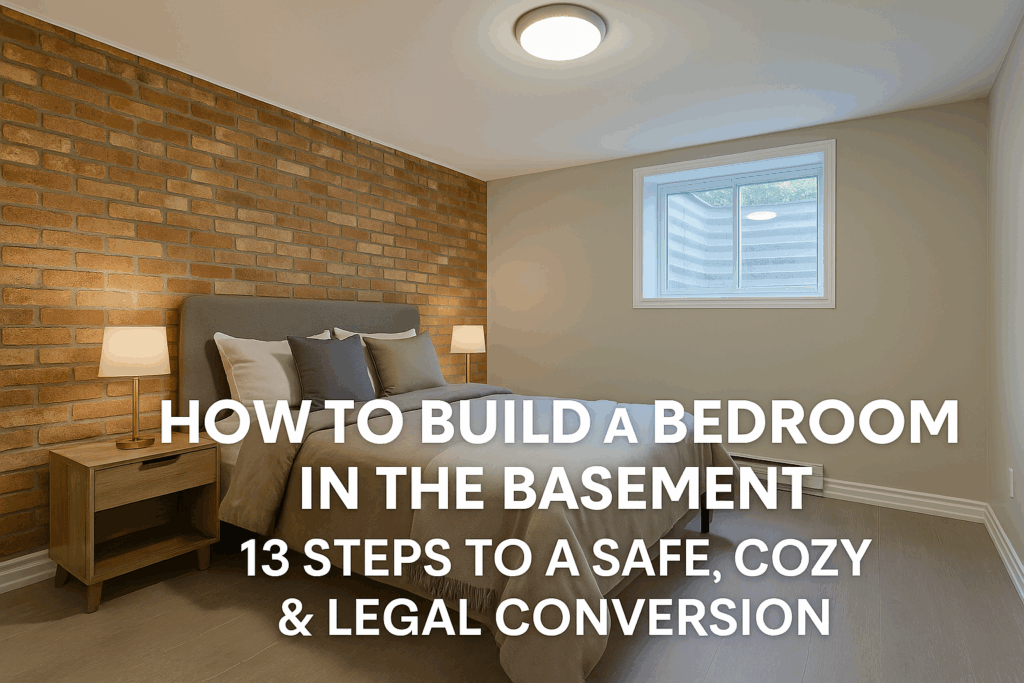
Now imagine this: soft lamplight on freshly painted walls, a warm rug under your feet, and the faint hum of an HVAC system keeping the air perfectly steady. It doesn’t feel like a basement anymore, it feels like another part of your home.
In this article, we will share 13 steps on how to build a bedroom in the basement. So let’s start.
Step 0: Get Your Paperwork and Budget Straight
Let’s be real: permits and budgets aren’t exciting. But skipping them? That’s how you end up staring at a half-built room you can’t legally use.
In Long Beach and across Tarrant County, inspectors don’t mess around, especially with bedrooms below grade. You’ll need to pull permits for framing, electrical work, egress windows, and HVAC. It’s bureaucracy, sure, but it also protects your investment when you eventually sell.
Budget? Be honest. A DIY-leaning conversion runs $8,000–$15,000. A full-scale, all-professional project? $15,000–$30,000. And always leave a buffer — old basements have secrets.
Local hack: Ask the city about bundled permits. It can shave time (and money) off your project.
At Recast Industries, we line up permits and realistic budgets before the first hammer swings. It’s how you avoid the “stuck mid-project” nightmare.
Step 1: Know the Rules Before You Swing a Hammer
You know that voice in your head saying, “Can I really just turn this into a bedroom?”. Here’s the truth: not without playing by the rules.
In Long Beach (and pretty much everywhere), a “bedroom” isn’t legal unless it checks these boxes:
- Egress: A window or door big enough for someone to crawl out , 5.7 sq. ft. opening, no higher than 44 inches from the floor.
- Ceiling height: About 7 feet (some older homes get exceptions, but don’t bank on it).
- Ventilation & heat: You need fresh air and a way to keep it at 68°F or above.
- Smoke & CO detectors: Non-negotiable.
Step 2: Waterproof Like Your Future Depends On It
You know that faint, musty smell you get when you first open a basement door? That smell is a warning.
Here’s my confession: I’ve seen too many homeowners skip waterproofing to “save money”, and call us months later when mold crept up behind their brand-new drywall. It’s ugly. It’s expensive. And it’s avoidable.
Start with a detective’s eye:
- Look for dark streaks or chalky residue on walls. That’s water sneaking in.
- Check corners for rusty nails or damp wood, slow leaks love to hide there.
- Test for radon. It’s invisible, but North Texas basements are notorious for it.
Your defense plan:
- Seal every wall and floor joint with a proper vapor barrier.
- Add a sump pump if water pools during heavy rain.
- Run a dehumidifier to keep humidity between 40–60%.
Step 3: Plan Your Layout for Comfort & Flow
You don’t want this to feel like a basement. You want it to feel like a bedroom you actually want to be in. Here’s where people mess up: they jump straight to framing without walking the space on paper first.
Start with the bed. Where does it go? Ideally near the egress window — it’s safer, and you’ll wake up to actual sunlight instead of staring at a blank wall.
Map your pathways. Can you walk from the door to the closet without bumping into furniture? If not, rethink it.
Plan for storage. Basements have weird nooks and beams — use them. Build in a closet under the stairs or add shelving between studs.
Here’s the part people always forget: mechanicals. That ugly column in the middle? You can’t move it. But you can wrap it in built-ins or make it part of a divider wall.
Pro tip: Use painter’s tape to outline furniture on the floor. Walk through it. If it feels cramped in tape, it’ll feel worse in reality.
We walk every Recast project like this before a single wall goes up. It’s cheaper to move tape than to move lumber.
Step 4: Add an Egress Window: Non-Negotiable
Close your eyes for a second. Picture yourself in that basement at 2 a.m., smoke in the air, and your only exit is the staircase. Does that feel safe?
That’s why egress windows aren’t “nice-to-have.” They’re life-or-death, and the inspector knows it too.
The essentials:
- Opening: At least 5.7 sq. ft., so an adult (or firefighter in gear) can get through.
- Height: Bottom no higher than 44 inches off the floor.
- Width & height: Minimum 20 x 24 inches.
- No tools: It must open fast, no keys or tricky latches.
Add one, and your room instantly changes: more light, more safety, more value.
Cost: Usually $2,500–$5,000, depending on digging and finishing.
We’ve installed dozens in Long Beach homes. At Recast Industries, we get them done right the first time — no “failed inspection” nightmares.
Step 5: Insulate for Warmth & Soundproofing
Walk into a poorly insulated basement, and you’ll know instantly. It’s cold, echoey, and uninviting, like a storage locker, not a bedroom.
Confession? We’ve seen too many people skip proper insulation to cut costs, only to call us back when the room felt like a cave no one wanted to sleep in.
Here’s how to get it right:
Insulation options at a glance:
| Type | Why Use It | Cost |
| Spray foam | Seals air gaps, resists moisture | $$$ |
| Mineral wool | Fire-resistant, excellent soundproofing | $$ |
| Fiberglass batts | Budget-friendly, easy DIY | $ |
Pro Tip: Pair insulation with acoustic panels or resilient channels for real soundproofing. Because nothing ruins a good night’s sleep like hearing every footstep above.
Cost: Around $1,500–$3,000 for a pro installation, but worth every penny for comfort.
At Recast Industries, we insulate every basement bedroom like someone’s moving in tomorrow, because they are.
Step 6: Get the Air Right — Heating, Cooling & Fresh Breathing Space
You know that heavy, stale basement air that makes you want to walk right back upstairs? That’s what we’re fixing here.
Basement bedrooms need proper climate control, not just for comfort, but to meet code.
Your options at a glance:
| System | Best For | Cost |
| Extend HVAC | Consistent whole-home comfort | $$ |
| Mini-split | Independent control, efficient | $$$ |
| Dehumidifier | Moisture control & air freshness | $ |
Pro Tip: Add a separate thermostat for the basement. It keeps you from freezing the upstairs just to make the basement livable.
Cost: Anywhere from $1,500–$5,000, depending on what you install.
We design ventilation like people actually live there — because they do. At Recast Industries, no one should walk into a basement and think, “It smells like a basement.”
Step 7: Frame It & Wire It Like a Real Room
This is when the basement stops looking like storage and starts becoming a bedroom.
Framing first:
- Use pressure-treated lumber anywhere it touches concrete, skip it, and you’re inviting rot.
- Plan for closets, built-ins, and niches now. It’s cheaper than retrofitting later.
- Work around columns and mechanicals, or better yet, hide them inside walls or custom cabinetry.
Then electrical:
- Dedicated circuits for safety. Bedrooms can’t share power with your basement freezer.
- GFCI outlets where moisture might creep in.
- Pre-wire for lighting, ceiling fans, and even Ethernet before the drywall goes up.
Confession? We’ve walked into plenty of DIY jobs where people thought wiring was “easy.” The inspector disagreed. And they had to tear it all out.
Cost: Plan for $3,000–$7,000, depending on complexity.
We map every outlet, switch, and stud placement before the first 2×4 is cut. At Recast Industries, no one likes ripping out fresh work because of poor planning.
Step 8: Hang Drywall & Paint With Light in Mind
Once the framing’s done, it’s time to give your basement real skin. This is where it finally starts feeling like a bedroom.
Drywall:
- Use moisture-resistant boards (green or purple drywall). Basements demand it.
- Hang sheets horizontally, fewer seams, cleaner look.
- Don’t rush the mudding and sanding. Sloppy drywall shows forever.
Paint:
- Skip harsh pure white, it makes basements feel sterile.
- Go for high light-reflective colors: soft creams, warm grays, even a muted beige.
- Use satin or eggshell finishes. They reflect light and are easy to clean.
Cost: Around $2,000–$5,000, depending on size and finish quality.
We design with light in mind. At Recast Industries, paint isn’t just a color, it’s how we make basements feel open instead of underground.
Step 9: Choose a Ceiling That Lifts the Room
A bad basement ceiling makes the room feel like a bunker. A good one? Opens it up and makes you forget you’re underground.
Your options:
| Type | Look & Feel | Pros | Cons |
| Drywall | Clean, seamless | Looks like any other room | Harder utility access |
| Drop ceiling | Functional & classic | Easy access for repairs | Slightly lowers height |
| Exposed beams | Industrial loft vibe | Maximizes height, saves cost | Requires painting/sealing |
Pro Tip: Paint the ceiling a shade lighter than your walls. It tricks the eye into feeling more height.
Cost: Anywhere from $1,500–$4,500, depending on materials and finishes.
Visual contrast:
- Before: Low, unfinished, pipes in sight.
- After: Smooth, bright ceiling that feels like part of the house.
We’ve raised more than ceilings — we’ve raised how people feel about their basements. At Recast Industries, design is about perception as much as structure.
Step 10: Select Flooring That Can Handle Basement Life
Your feet will thank you for this step. The right flooring makes a basement feel warm, not like walking on a cold slab.
Options at a glance:
| Type | Feel & Look | Pros | Cons |
| Luxury vinyl plank | Wood-look, warmer touch | Waterproof, budget-friendly | Can feel cold without rugs |
| Engineered wood | True wood feel | Upscale look, cozy underfoot | Needs a moisture barrier |
| Carpet tiles | Soft, homey | Easy to replace if damaged | Less moisture resistant |
| Epoxy | Sleek & modern | Ultra-durable, easy clean | Cold, needs rugs |
Pro Tip: Always install a vapor barrier or subfloor system first. Skipping it is how you end up with warped boards or damp carpet.
Cost: Ranges from $1,200–$6,000, depending on material and square footage.
Step 11: Light It Like You Actually Live There
One lonely bulb in the middle of the ceiling? That’s how basements stay basements. Good lighting makes it feel like a real room.
Layer your lighting:
| Type | Purpose | Feel It Creates |
| Ambient | Overall brightness | Open, welcoming |
| Task | Bedside, reading, dressing | Functional & cozy |
| Accent | Wall sconces, uplights | Adds depth & style |
Pro Tip: Put everything on dimmers. Bright for laundry day, soft for winding down.
Cost: $800–$5,000, depending on design and fixtures.
At Recast Industries, we design lighting plans that change the mood of a room with a switch, because the right lighting makes a basement feel alive.
Step 12: Furnish & Dress It Like a Real Bedroom
Now that the structure’s done, it’s time to make it feel like somewhere you actually want to spend time.
Furnish smart:
- Use multi-purpose pieces, storage ottomans, Murphy beds, built-in shelves — to save space.
- Add mirrors to bounce light and make the room feel bigger.
Layer in comfort:
- Rugs over hard floors, soft throws, and textured bedding instantly change the vibe.
- Bring in warm wood tones and earthy fabrics to fight that “cold basement” feel.
Pro tip: Keep the style consistent with the rest of your house. If it looks like an afterthought, it’ll feel like one.
We stage every Recast basement like someone’s moving in tomorrow. Because when it’s done right, this room won’t just be functional — it’ll be the one everyone wants to stay in.
Step 13: Do a Final Safety & Comfort Walkthrough
Before you call it done, make sure it’s ready for real life, not just for photos.
Safety checks:
- Test smoke and carbon monoxide detectors.
- Retest radon levels if you installed mitigation.
- Make sure your egress window opens smoothly, no sticking, no tools needed.
- Seal gaps where pests could sneak in.
Comfort checks:
- Adjust thermostats or mini-splits for consistent temps.
- Do a deep clean to clear drywall dust.
- Spend a night down there, you’ll notice what needs tweaking.
Why this matters: These last steps are how you turn a construction project into a livable, safe bedroom you trust.
At Recast Industries, we don’t hand off projects until we walk them like we live there. It’s how we make sure every basement bedroom feels move-in ready from day one.
What Does It Really Cost to Build a Basement Bedroom?
DIY approach:
- Framing & insulation: $3,000–$6,000
- Drywall & paint: $2,000–$4,000
- Flooring: $1,200–$3,000
- Electrical & lighting: $2,000–$3,000
- Total: $8,000–$15,000
Full professional remodel:
- Turnkey project with permits, waterproofing, egress, HVAC, finishes: $15,000–$30,000
ROI: A legal, finished basement bedroom adds 50–70% of its cost back in home value — even more if it creates a guest or in-law suite.
10 Quick FAQs About Basement Bedrooms
1. Do I need a permit for a basement bedroom?
Yes. Without one, it won’t be recognized as legal living space.
2. What makes a basement bedroom “legal”?
An egress window/door, proper ceiling height, heating, ventilation, and smoke/CO detectors.
3. How much does an egress window cost?
Typically $2,500–$5,000, depending on excavation and finishing.
4. What’s the best flooring for basement bedrooms?
Luxury vinyl plank — waterproof, durable, and cost-effective.
5. How do I keep the room warm?
Insulate well, add rugs, and extend HVAC or use a mini-split system.
6. Should I waterproof first?
Always. It prevents mold, water damage, and costly repairs later.
7. Can I DIY a basement bedroom conversion?
Parts, yes. But hire pros for wiring, HVAC, and egress windows to pass inspection.
8. How long does it take?
Usually 4–8 weeks, depending on permits and scope.
9. Will it add value to my home?
Yes. Appraisers count it as finished living space if it meets code.
10. How do I make it feel less “basement-y”?
Use layered lighting, mirrors, warm finishes, and décor consistent with the rest of your house.
Your Basement Can Be the Best Room in Your Home
When done right, your basement isn’t just extra square footage, it’s a true extension of your home. A cozy retreat. A guest-ready suite. A space that adds value in every sense of the word. At Recast Industries, we help Long Beach homeowners transform basements into bright, code-compliant bedrooms that feel like they’ve always belonged. Don’t wait on “someday.” Book your no-obligation consultation today and see what’s possible.
